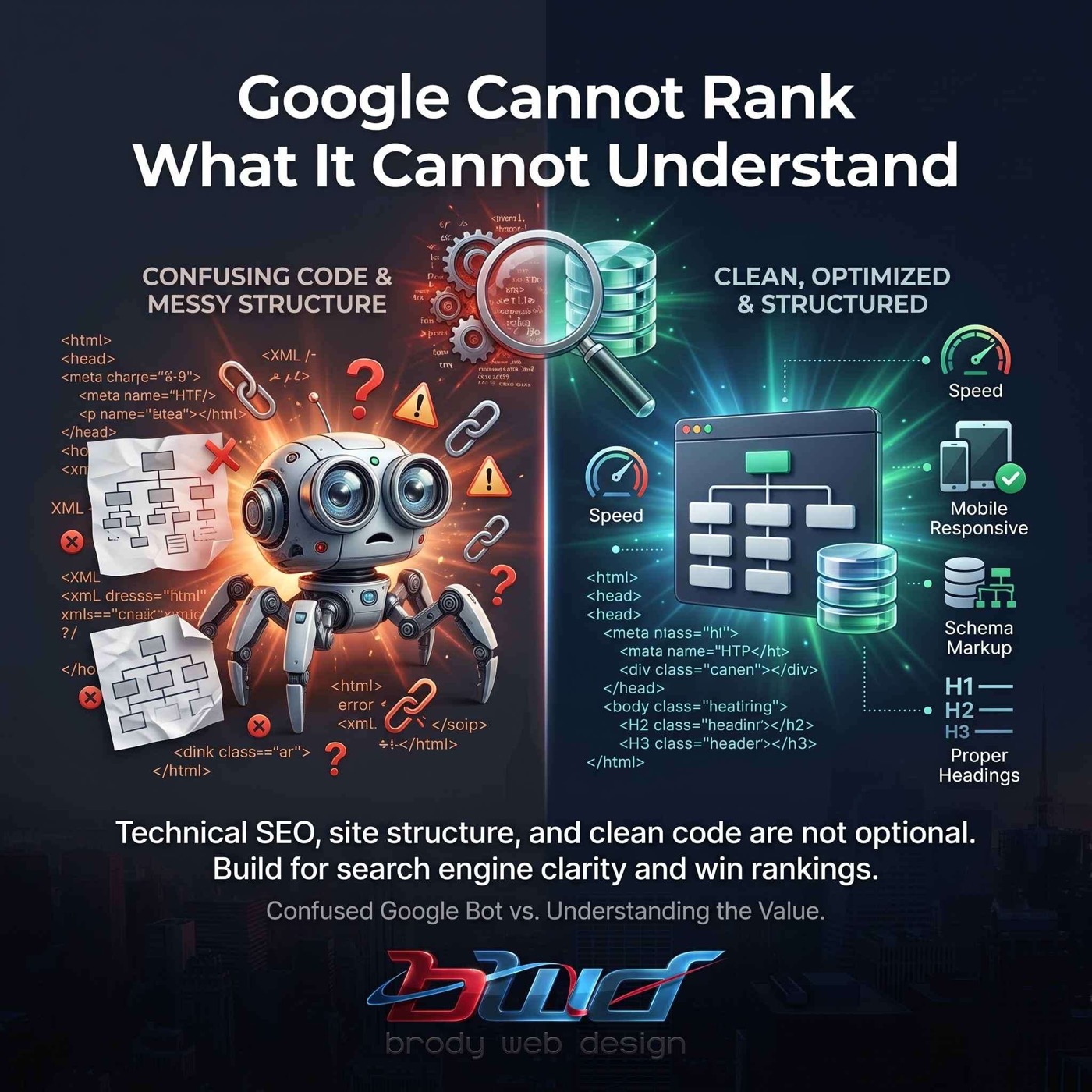
Google Cannot Rank What It Cannot Understand
Your website may look impressive to visitors, but what does Google see when it examines the pages, structure, content, and code behind the design?
If search engines cannot clearly understand what your business does, where it operates, and which services it provides, your website may struggle to appear when potential customers search for those services. That is why effective search engine optimization requires more than adding keywords to a page.
Technical SEO, organized content, clean code, internal links, mobile performance, and a logical website structure all help search engines understand and properly index your website.
How Does Google Understand a Website?
Google uses automated programs to discover and analyze webpages. These systems examine many elements, including:
- Page titles and headings
- Written website content
- Internal and external links
- Website navigation and page structure
- Image descriptions and alternative text
- Mobile usability
- Page loading speed
- Structured data and schema markup
- Local business information
- Overall website accessibility
When these elements are properly organized, Google has a better chance of understanding your website and matching its pages with relevant searches. When they are missing, inconsistent, or poorly implemented, your website can become difficult for both search engines and customers to navigate.
A Beautiful Website Is Not Automatically an Optimized Website
A website can look modern and professional while still having serious SEO problems behind the scenes. Attractive colors, images, and animations do not tell Google what your company offers.
Some visually impressive websites suffer from slow loading times, confusing navigation, missing headings, duplicate content, broken links, and bloated code. These problems can interfere with search engine crawling while also creating a frustrating experience for visitors.
Professional website design and development should combine visual appeal with functionality, performance, usability, and search engine visibility. Every part of the website should work together to support your business goals.
Common Problems That Make Websites Difficult to Understand
Missing or Improper Heading Structure
Headings organize the information on a page. The primary heading should clearly introduce the subject, while supporting headings divide the content into logical sections.
When headings are missing or used only to change the appearance of text, search engines may have difficulty identifying the page’s main topic and supporting information.
Thin or Generic Website Content
A short paragraph containing only broad statements usually does not give Google or potential customers enough information. Each important service should have useful content explaining what the service is, who it helps, where it is available, and why customers should choose your business.
Strong content should answer real customer questions while naturally using phrases related to the service. It should be written for people first, while still giving search engines the context they need.
Broken Links and Error Pages
Broken links can send visitors and search engines to missing pages. Too many broken links may indicate that a website is poorly maintained and can prevent search engines from efficiently discovering important content.
Regular website maintenance should include checking internal links, repairing missing pages, updating outdated URLs, and properly redirecting content that has moved.
Confusing Navigation
Visitors should not have to search through multiple menus to find basic information. Google also relies on navigation and internal links to discover the relationship between your pages.
A logical structure may begin with a primary services page that connects to individual service pages. Those pages can then link to related articles, frequently asked questions, portfolio examples, and the contact page.
You can explore the complete range of available solutions on the Brody Web Design services page.
Slow Loading Speed
Large images, unnecessary scripts, outdated plugins, poor hosting, and excessive code can slow down a website. Customers may leave before the page finishes loading, especially when browsing from a mobile device.
Improving speed can provide a better user experience while making it easier for search engines to access and process your content.
Poor Mobile Performance
Your website should be easy to read and navigate on phones, tablets, laptops, and desktop computers. Buttons should be easy to select, text should remain readable, and forms should work correctly on smaller screens.
Mobile optimization is no longer an optional feature. It is a fundamental part of professional web development and online marketing.
Why Internal Links Matter for SEO
Internal links connect one page of your website to another. They help visitors discover related information and help search engines understand which pages are important.
For example, an article about improving search visibility should naturally connect readers to information about SEO services in Phoenix. A discussion about website performance can connect to a relevant Phoenix web design service.
Internal links should be descriptive and useful. Adding random links solely for SEO can make the content feel unnatural and may not provide meaningful value.
How Schema Markup Helps Google
Schema markup is code that provides search engines with additional context about a business and its content. Depending on the page, schema can identify details such as:
- The name and type of business
- Services offered
- Business location and service area
- Telephone number and contact information
- Frequently asked questions
- Articles and blog posts
- Products, pricing, and availability
Schema does not guarantee higher rankings. However, properly implemented structured data can make information easier for search engines to interpret and may support enhanced search result features when the page qualifies.
Local SEO Requires Consistent Business Information
Local businesses need to make their location and service area clear. The company name, address, phone number, services, and operating information should remain consistent across the website and other trusted online profiles.
Brody Web Design helps businesses improve their websites and online visibility throughout Phoenix, Glendale, Scottsdale, and surrounding Arizona communities. You can also find Brody Web Design on Google Maps.
SEO Is More Than Installing a Plugin
SEO plugins can help manage titles, descriptions, sitemaps, and other settings. However, installing a plugin does not automatically optimize a website.
A successful SEO strategy may require technical corrections, keyword research, original content, page restructuring, internal linking, local optimization, conversion improvements, ongoing monitoring, and professional judgment.
The tools are valuable, but they still need to be configured and used as part of a complete strategy.
Build Your Website for Search Engines and Customers
Search engines and customers often want many of the same things. They both benefit from fast pages, helpful content, clear navigation, organized information, secure browsing, and a website that works properly on mobile devices.
The goal is not to build a website exclusively for Google. The goal is to create a professional online resource that clearly communicates what your business offers and makes it easy for customers to take the next step.
With more than 25 years of experience, Brody Web Design combines website development, technical knowledge, content strategy, and digital marketing to help businesses establish stronger online foundations.
Learn more about Brody Web Design and our experience.
Is Your Website Sending Google the Right Message?
If your website is not generating traffic, calls, contact form submissions, or sales, the problem may go deeper than its appearance. Search engines might not clearly understand your content, services, structure, or location.
Brody Web Design can review your website and identify issues involving technical SEO, content, internal links, page structure, mobile usability, speed, and conversion strategy.
Do not let confusing code, broken links, and poorly organized content keep your business hidden. Give search engines the information they need and give customers a website they can trust.
Ready to Improve Your Website Visibility?
Contact Brody Web Design to discuss professional SEO, website design, technical optimization, content development, and digital marketing services.
Call: 602.397.5577
Website: https://www.brodywebdesign.com
Frequently Asked Questions
Why is Google not ranking my website?
Your website may have technical problems, insufficient content, weak internal linking, slow loading speeds, poor mobile usability, strong competition, or limited authority. An SEO review can help identify the issues affecting your visibility.
Does clean website code improve SEO?
Clean and organized code can make a website easier to maintain and may help search engines efficiently access its content. Code quality should be combined with useful content, logical structure, speed, mobile usability, and other SEO practices.
Can an SEO plugin rank my website?
An SEO plugin can assist with important settings, but it cannot replace a complete strategy. Rankings depend on many factors, including content quality, website performance, competition, relevance, authority, and technical implementation.
What is technical SEO?
Technical SEO involves improving the elements that affect how search engines crawl, process, and index a website. This can include site architecture, speed, mobile performance, security, structured data, redirects, canonical tags, and broken link corrections.
How long does SEO take to work?
SEO is generally an ongoing process rather than an instant result. The timeline depends on the website’s current condition, competition, market, existing authority, content, and the amount of work required.

